Five athletes. Five different journeys. One powerful reminder: the greatest victories in life are not always measured on a scoreboard.
A one-of-one vintage NFL card exhibition featuring Frank Reich, Kerry Collins, Ed McCaffrey, Gus Frerotte, and Pat Swilling.
Frank Reich spent years preparing for opportunities that rarely came. When his moment arrived, he helped lead one of football's most remarkable comebacks.
Kerry Collins faced the consequences of serious personal mistakes. Through rehabilitation, responsibility, and meaningful changes, he worked to rebuild his life and contribute to others.
Ed McCaffrey returned from a devastating injury and later found new ways to serve children and young athletes beyond professional football.
Gus Frerotte built a fifteen-season NFL career despite long odds, setbacks, and an embarrassing moment that followed him for years. His journey continued through personal growth and finding purpose after football.
Pat Swilling achieved greatness as a defensive player, then pursued new responsibilities through public service, business, and community involvement.
Together, these five men reveal different forms of perseverance: preparation, rebuilding, recovery, perspective, and purpose.
AGAINST ALL ODDS is not simply about overcoming difficulties. It is about the choices people make when life does not unfold as expected.
Because sometimes the greatest victory is not defeating an opponent. It is becoming someone who continues to grow, contribute, and find meaning beyond the game.
The five stories
Chapter 1 · Frank Reich — READY
READY WHEN CALLED
The Frank Reich Story
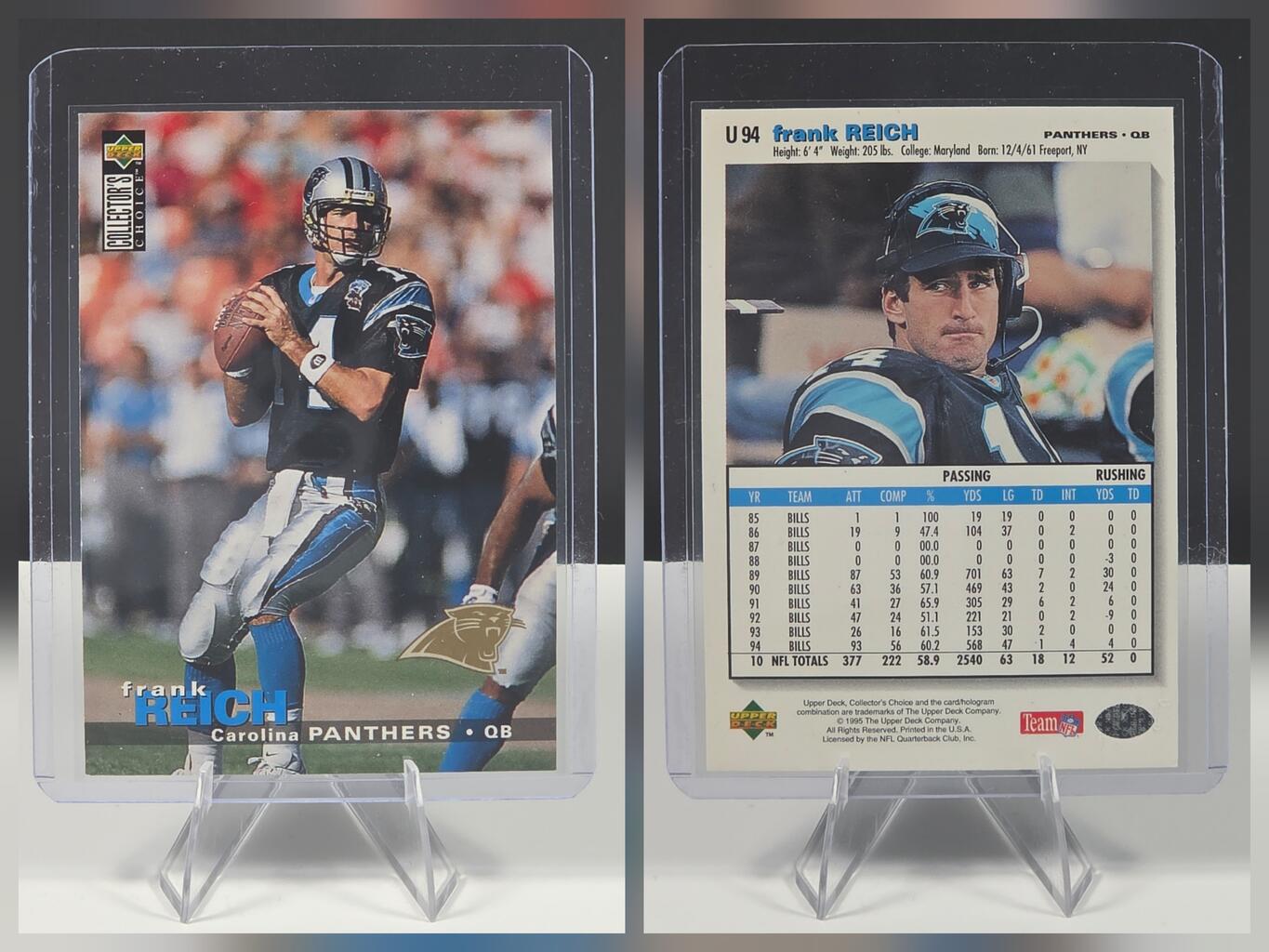
Physical Card: 1995 Upper Deck Collector's Choice Update #U94, Carolina Panthers
January 3, 1993. The Buffalo Bills were losing 35–3 to the Houston Oilers early in the third quarter of an NFL playoff game. Their starting quarterback, Jim Kelly, was injured, and backup Frank Reich had just thrown an interception returned for a touchdown.
A 32-point deficit seemed almost impossible to overcome. But Reich had faced something remarkably similar before.
In 1984, while playing for the University of Maryland, Reich entered a game against Miami with his team trailing 31–0 at halftime. He helped lead Maryland to an astonishing 42–40 victory.
Eight years later, another extraordinary challenge awaited him.
Reich joined Buffalo in 1985 and spent most of the following decade backing up Jim Kelly. He practiced, studied, and prepared, knowing his opportunities to lead the offense would be limited.
Being a backup required patience. His responsibility was to remain ready, even when someone else received the attention.
Against Houston, that preparation was tested.
Buffalo began fighting back. Kenneth Davis scored a touchdown, Steve Christie recovered an onside kick, and Reich connected with Don Beebe and Andre Reed for crucial scores.
Reich threw four touchdown passes. Buffalo's defense made important plays, and Christie eventually kicked the winning field goal in overtime.
The Bills won 41–38.
It was an unforgettable team achievement. For Reich, it demonstrated how years of preparation outside the spotlight could become meaningful when opportunity arrived.
But his life continued beyond that victory.
After fourteen NFL seasons, Reich retired from playing and pursued theological education. He served in ministry before returning to professional football as a coach.
He helped Philadelphia win Super Bowl LII as offensive coordinator, later became head coach of Indianapolis and Carolina, and coached Stanford in 2025. In 2026, he joined the New York Jets as offensive coordinator.
His journey included success, disappointment, changing responsibilities, and new beginnings. Through those chapters, he continued finding ways to learn, lead, and contribute.
👀 LOOK AT THE CARD AGAIN
Look at Frank Reich's football card again. It shows a quarterback whose name became part of football history, but it cannot reveal the years of preparation behind his opportunities.
The card reminds us that meaningful contributions are often built long before the world notices them.
💎 HIDDEN GEM — READINESS
Preparation matters even when opportunity seems far away. Reich's journey shows that waiting does not have to mean standing still.
Sometimes the quiet work we do today prepares us for responsibilities we cannot yet imagine.
💭 HIYASAT REFLECTION
There may be times when your efforts feel invisible, when someone else receives the opportunity you have been preparing for.
Frank Reich's story reminds us that these seasons can still have purpose. Keep learning, keep contributing, and keep becoming someone who is ready when the moment arrives.
The opportunity may be uncertain. The person you become while preparing is not.
Chapter 2 · Kerry Collins — REBUILT
The Kerry Collins Story
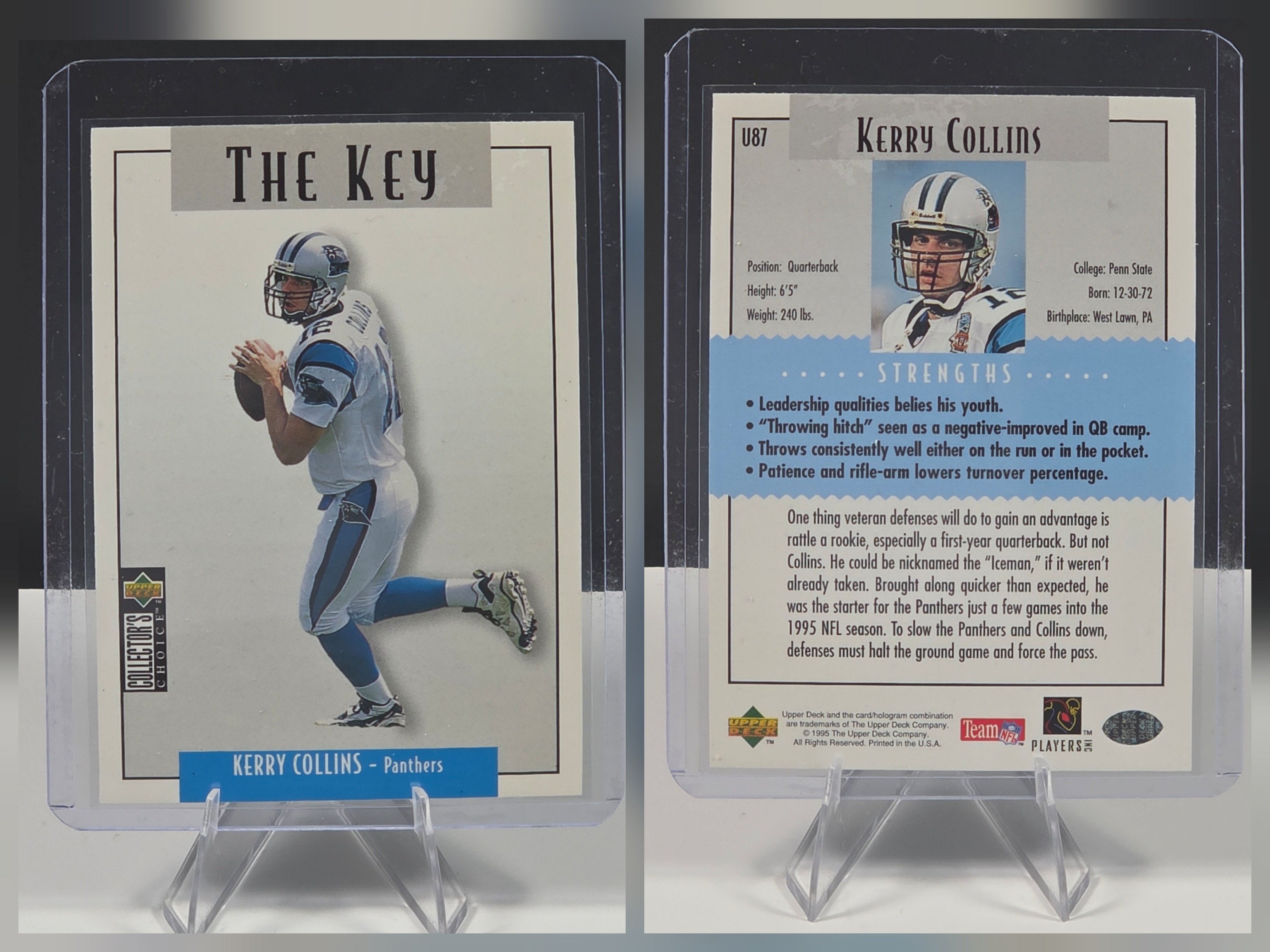
Physical Card: 1995 Upper Deck Collector's Choice Update #U87, Carolina Panthers
In 1998, Kerry Collins was watching his promising football career unravel. Once celebrated as one of America's finest college quarterbacks, he was struggling with alcohol, facing the consequences of his decisions, and losing the trust of people around him.
At Penn State, Collins had led an undefeated 1994 team. The Carolina Panthers selected him fifth overall in the 1995 NFL Draft, making him the first player drafted in franchise history. By 1996, he had helped Carolina reach the NFC Championship Game.
Yet professional success could not protect him from personal struggles.
In 1997, Collins used a racial slur toward a teammate, causing harm and controversy. In November 1998, he was arrested for impaired driving. He was subsequently convicted after entering a no-contest plea.
Collins publicly acknowledged his wrongdoing. But accepting responsibility was only the beginning.
In early 1999, he completed an alcohol rehabilitation program. There, he began confronting his destructive behaviour and examining the choices that had damaged his life and relationships.
He could not change yesterday. He could choose how to live tomorrow.
With the New York Giants, Collins gradually rebuilt his career. Teammates who had initially questioned him began noticing changes in his behaviour and attitude.
In the 2000 season, he helped the Giants reach Super Bowl XXXV. His NFL career eventually lasted seventeen seasons.
But his most meaningful rebuilding happened beyond football.
Collins shared his experiences with approximately 250 incoming NFL players, helping them understand the consequences of poor decisions. Through the Kerry Collins Foundation, he contributed more than $2 million to charitable causes, supporting people and communities beyond the sport.
His charitable involvement had begun earlier in his career, but giving back remained part of his journey.
After retirement, Collins explored songwriting and other interests beyond professional football.
In a 2016 interview, he reflected on his difficult years. What mattered most to him was not recovering his football reputation, but becoming a healthier person and learning to live a better life.
👀 LOOK AT THE CARD AGAIN
Look at Kerry Collins's football card again. It shows an accomplished quarterback, but it cannot reveal the difficult personal work behind his later years.
The card becomes a reminder that a person's story is larger than either their greatest achievement or their worst mistake.
💎 HIDDEN GEM — REBUILDING
We cannot rewrite yesterday, but we can take responsibility for today and build a different tomorrow.
Collins's journey reminds us that rebuilding requires more than regret. It takes honest reflection, meaningful changes, and actions that demonstrate the person we are becoming.
💭 HIYASAT REFLECTION
Every life contains decisions we wish we could change. What matters afterward is whether we learn, accept responsibility, and make better choices.
Kerry Collins's story reminds us that growth is possible when we are willing to do the work.
The past remains part of our story. But the future is still ours to build.
Chapter 3 · Ed McCaffrey — RETURN
The Ed McCaffrey Story
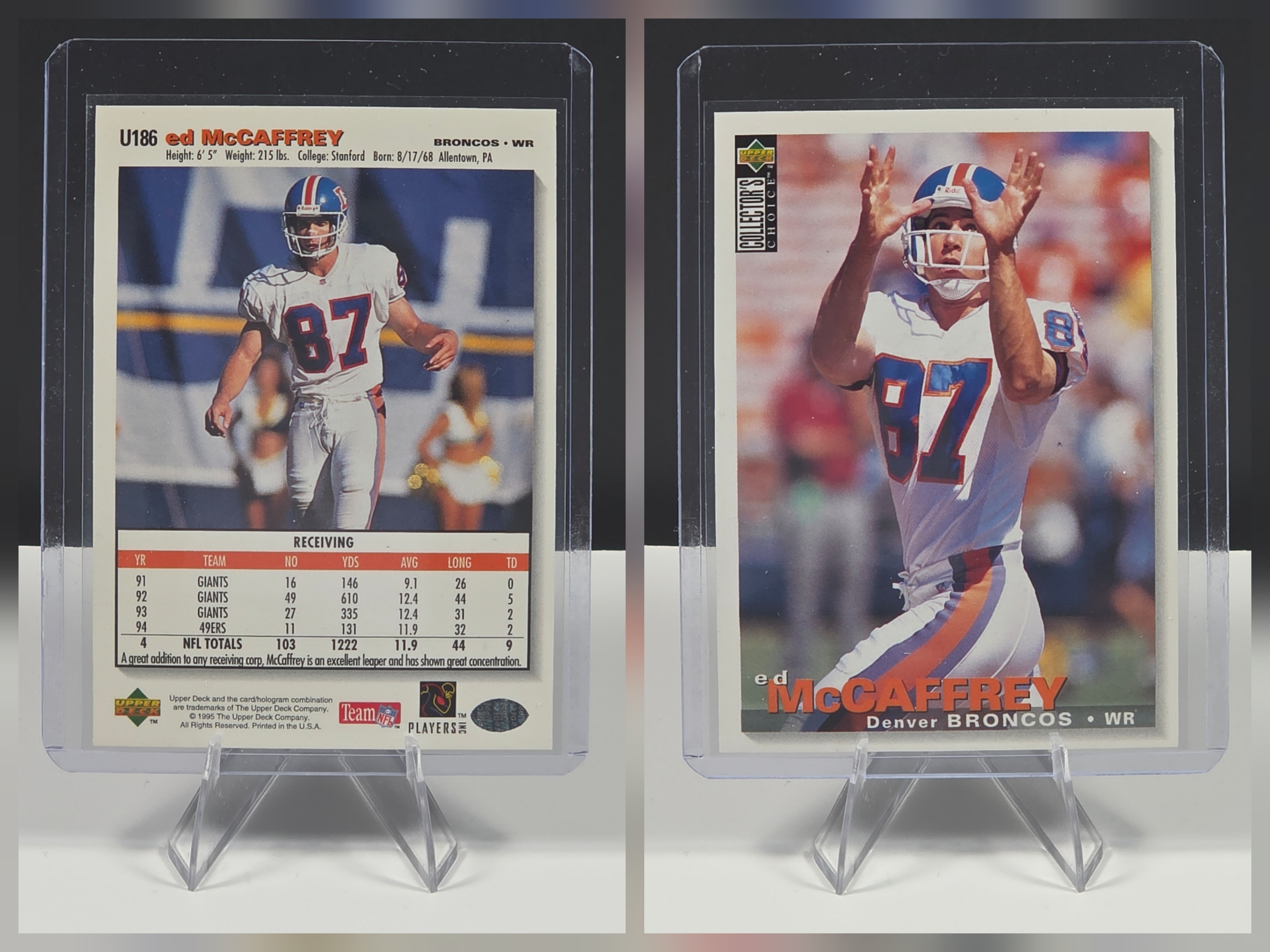
Physical Card: 1995 Upper Deck Collector's Choice Update #U186, Denver Broncos
September 10, 2001. Denver Broncos receiver Ed McCaffrey reached for a football against the New York Giants. He made a difficult catch, but the collision that followed broke his left leg. His season ended almost as soon as it began.
For a player who had worked years to establish himself, the injury threatened everything he had built.
McCaffrey's journey began at Stanford University, where he developed into an All-American receiver. The New York Giants drafted him in 1991, but his early NFL years offered limited opportunities to stand out.
In 1994, he joined San Francisco and earned his first Super Bowl championship. A year later, he signed with Denver, where he became an important part of the Broncos' offense.
Alongside John Elway and Rod Smith, McCaffrey helped Denver win consecutive Super Bowls. His dependable receiving and willingness to make difficult catches earned respect throughout the league.
In 2000, he enjoyed his finest statistical season, catching 101 passes for 1,317 yards. He had reached a level of success that once seemed uncertain.
Then came the broken leg.
McCaffrey underwent surgery and faced months of rehabilitation. Instead of preparing for games, he had to rebuild his strength and work toward playing again.
In 2002, he returned for all sixteen regular-season games. He caught 69 passes for 903 yards, proving that his contribution to the team had not ended with the injury.
He retired after the 2003 season with three Super Bowl championships. But retirement opened another chapter of service.
With his wife, Lisa, McCaffrey supported children facing medical, educational, and financial hardships through the McCaffrey Family Foundation. He also helped organize opportunities for children with Down syndrome to experience football and cheerleading.
He shared his knowledge through broadcasting and coaching. At Valor Christian High School, he helped lead a state championship team. His later college coaching experience at Northern Colorado was less successful, reminding us that new chapters do not always unfold as expected.
Through these changes, McCaffrey's life continued beyond professional football. His opportunities to contribute took different forms, from receiving passes to supporting children and mentoring younger athletes.
👀 LOOK AT THE CARD AGAIN
Look at Ed McCaffrey's football card again. It captures a championship receiver, but it cannot show the months of recovery after his injury or the lives he later sought to support.
Behind the uniform is a person whose contributions continued even as his circumstances changed.
💎 HIDDEN GEM — PERSEVERANCE
A setback can change our plans without ending our purpose. McCaffrey's journey reminds us that returning does not always mean returning to exactly what we were before.
Sometimes perseverance means finding another way to contribute.
💭 HIYASAT REFLECTION
Life can interrupt even our most carefully prepared plans. Recovery takes patience, and the future may look different from what we imagined.
Ed McCaffrey's story reminds us that our value is not limited to one role, achievement, or season. We can continue learning, helping, and finding purpose through every new chapter.
Chapter 4 · Gus Frerotte — BEYOND
The Gus Frerotte Story
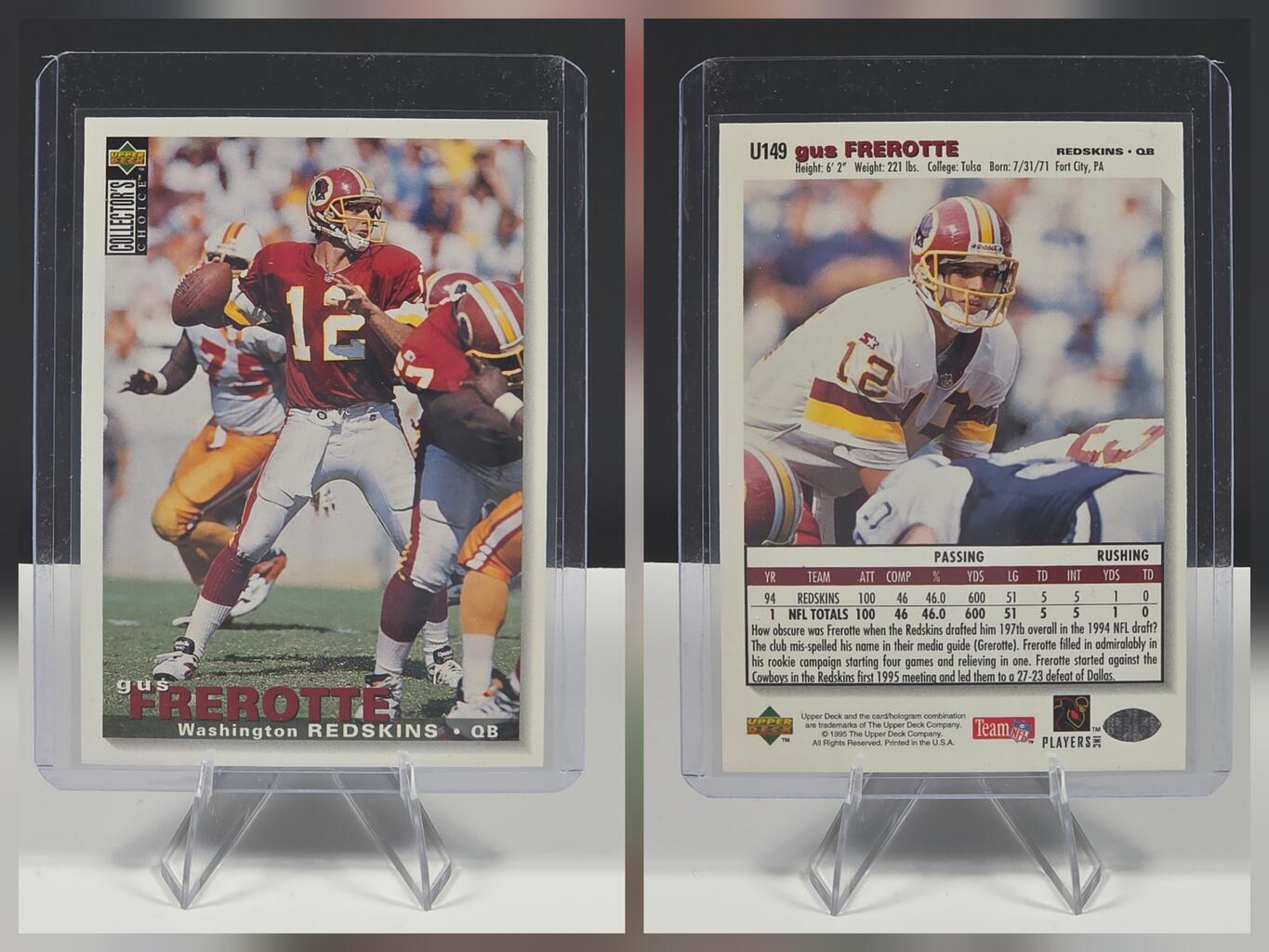
Physical Card: 1995 Upper Deck Collector's Choice Update #U149, Washington Redskins
In September 2008, the Minnesota Vikings turned to Gus Frerotte after losing their first two games. He was 37 years old, playing in his fifteenth NFL season, and had spent much of his career moving between starting and backup roles.
For someone selected near the end of the NFL Draft, simply reaching that point was an extraordinary achievement.
Frerotte grew up in Pennsylvania and played college football at the University of Tulsa. Washington selected him in the seventh round of the 1994 NFL Draft, 197th overall. Few players drafted that late build long professional careers.
But Frerotte earned opportunities. By 1996, he was Washington's starting quarterback, throwing for 3,453 yards and earning a Pro Bowl selection.
Then came an unforgettable mistake.
On November 23, 1997, Frerotte scored a touchdown against the New York Giants. While celebrating, he struck his helmet against a padded stadium wall and injured his neck.
The incident became a famous football blooper. Even years later, fans continued reminding him of that moment.
But Frerotte's career was far bigger than one embarrassing celebration.
He continued playing for Washington and later joined Detroit, Denver, Cincinnati, Minnesota, Miami, and St. Louis. Different coaches, teammates, and responsibilities required him to keep adapting.
In 2005, he started fifteen games for Miami. Three years later, Minnesota needed him again.
Frerotte helped the Vikings win eight of his eleven starts in 2008. The team finished 10–6 and won the NFC North division title.
He eventually retired after fifteen NFL seasons, having played 147 games and thrown 114 touchdown passes.
But leaving football brought another challenge.
Frerotte had spent much of his life surrounded by teammates. Retirement meant losing the daily connection and shared purpose that professional football had provided.
He later spoke openly about struggling with his mental health and seeking professional support. With encouragement from his family, he learned that asking for help was not weakness.
Frerotte also explored coaching, podcasting, and business. Through his Alumni Media Network, he sought to reconnect former athletes and help them navigate life beyond professional sports.
In a later interview, he discussed finding joy in family, learning new skills, and supporting others through difficult transitions.
👀 LOOK AT THE CARD AGAIN
Look at Gus Frerotte's football card again. It represents a quarterback who built a fifteen-season career despite long odds.
But the card also invites us to discover the man who continued learning and finding purpose after the cheering stopped.
💎 HIDDEN GEM — PERSPECTIVE
One embarrassing moment cannot measure an entire life. Neither can professional success.
Frerotte's journey reminds us that growth continues when we accept our experiences, seek help when needed, and remain open to new beginnings.
💭 HIYASAT REFLECTION
Perhaps there is a mistake you wish people would forget, or a chapter of life you are struggling to leave behind.
Gus Frerotte's story reminds us that our future deserves more attention than our most embarrassing moment.
We cannot always control what others remember. But we can continue deciding who we become.
Chapter 5 · Pat Swilling — PURPOSE
The Pat Swilling Story
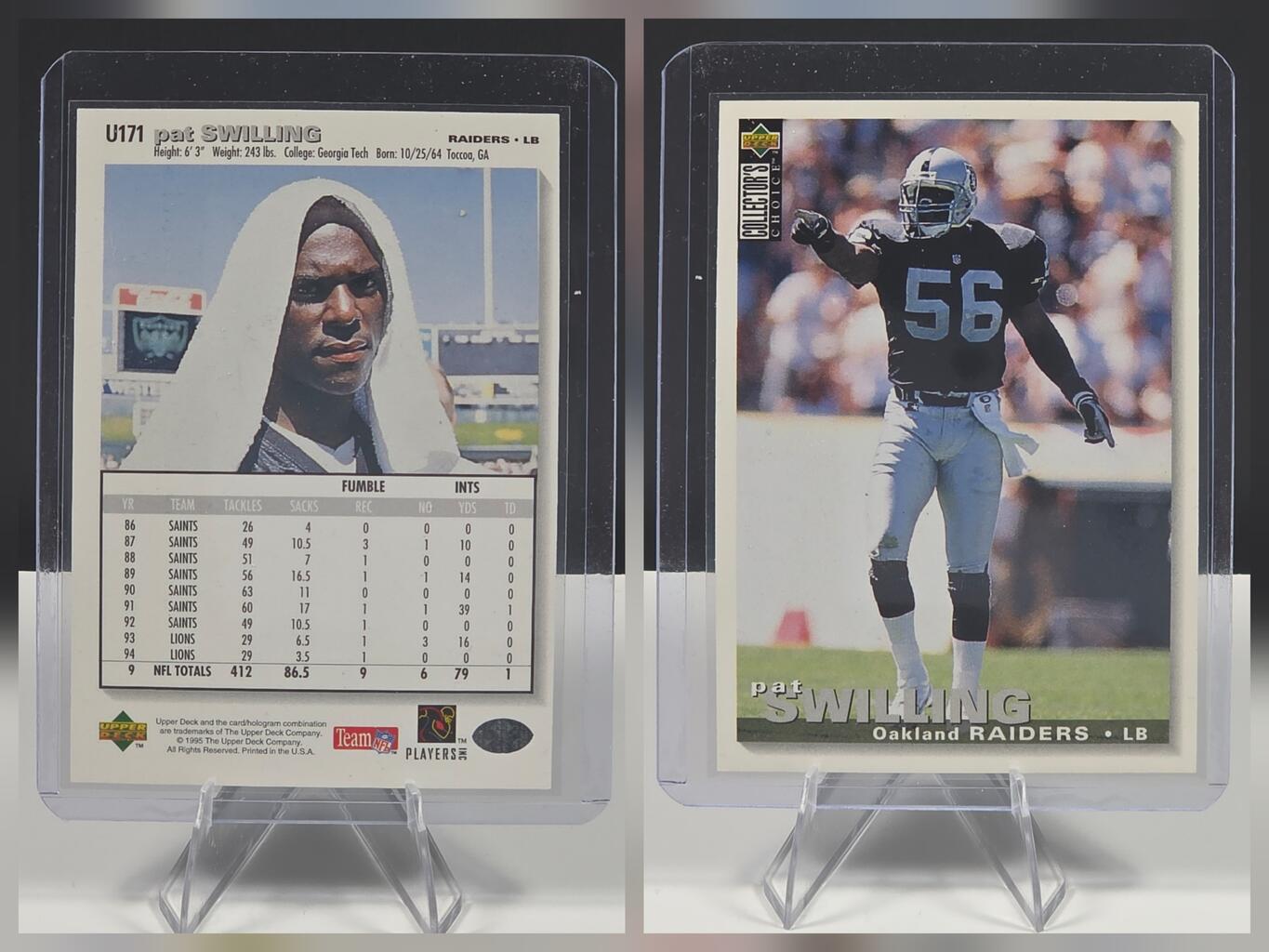
Physical Card: 1995 Upper Deck Collector's Choice Update #U171, Oakland Raiders
On March 26, 2001, Pat Swilling stood before the Louisiana House of Representatives and took his oath of office. Years earlier, he had been one of football's most feared defenders. Now, he was beginning a different kind of responsibility: representing the people of his community.
For Swilling, football had brought recognition and success. But his ambitions had never been limited to the playing field.
Born in Toccoa, Georgia, Swilling grew up around people who worked in construction. His father and uncle were subcontractors, and watching their work sparked an interest in building things that would stay with him long after football.
At Georgia Tech, he joined a struggling football program and became part of its revival. By 1985, he was an All-American defensive player, recording seven sacks in one game against North Carolina State.
The New Orleans Saints selected him in the third round of the 1986 NFL Draft. There, he joined Rickey Jackson, Sam Mills, and Vaughan Johnson to form the legendary Dome Patrol linebacking group.
Together, they helped transform a franchise that had never reached the playoffs. In 1987, New Orleans celebrated its first winning season and playoff appearance.
Swilling's greatest individual achievement came in 1991. He led the NFL with 17 sacks, earned Defensive Player of the Year honors, and helped the Saints capture their first division championship.
He eventually played for Detroit and Oakland, finishing his NFL career with 107.5 sacks and five Pro Bowl selections.
Yet Swilling had already begun preparing for another future.
While still playing, he purchased property in New Orleans and developed an interest in real estate. After football, he expanded that work, establishing a development business focused largely on properties in the city's eastern neighborhoods.
In 2001, he was elected to represent Louisiana's 100th House District. He served approximately two and a half years in the state legislature, taking on responsibilities far removed from football.
His work in property development also continued. In a later interview, he described developing dozens of buildings in New Orleans, reflecting an ambition that had begun during his childhood.
Swilling's journey was not simply a transition from one successful career to another. It was a reminder that a person's abilities and interests can grow beyond the role that first made them famous.
👀 LOOK AT THE CARD AGAIN
Look at Pat Swilling's football card again. It captures an exceptional athlete whose achievements helped change the history of the New Orleans Saints.
But behind that image is a man who continued building, learning, and accepting new responsibilities after football.
💎 HIDDEN GEM — PURPOSE
Success in one chapter does not mean our greatest opportunities to contribute are behind us. Swilling's journey reminds us that our experiences can become foundations for new responsibilities.
Purpose does not disappear when one career ends. Sometimes it takes a different form.
💭 HIYASAT REFLECTION
We often define ourselves by what we do best. But life may offer opportunities to serve, create, or contribute in ways we never expected.
Pat Swilling's story invites us to look beyond our achievements and consider what we can build with the experience we have gained.
Our accomplishments matter. So does what we choose to do with them.